


TL;DR:
Sensitive data can leak without anyone stealing it: an authorized service carrying it somewhere the architecture never intended is enough. Machine learning uses the same phrase for target leakage: a contaminated training set. This article covers the privacy failure.
- Path one is your own training set: inference logs mined for a fine-tuning corpus, or a training job pointed at a live table.
- Once data has shaped model parameters, there is no record-level delete. Model inversion and membership inference make the weights a disclosure surface.
- Path two is the external model call, which exposes four separate data points from your infrastructure at once.
- Path three is data that was supposed to be anonymous. Pseudonymized records stay in scope, and quasi-identifiers survive redaction built for structured fields.
- Each path ends at a boundary gate, and each gate must leave a record a reviewer can read.
What AI data leakage means for a team that builds the model
The most expensive AI data leak tends to look like normal traffic. An authorized service sends a request with a valid key to an approved endpoint, the call succeeds, and the payload carries a patient’s history.
AI data leakage is sensitive data crossing a boundary through an AI component, whether during training or at inference, without a decision that put it there. Logs count as a destination.
Most results for data leakage AI queries address a different reader: the security team at a company whose staff paste internal documents into a public chatbot. That reader needs browser controls and an acceptable use policy. The problem here is narrower, because the model is yours and the data moving through it belongs to your customers.
The failure mode follows from that. There is no intrusion to detect and no credential to revoke. Perimeter tooling reads that as normal traffic, because by every signal it monitors, it is.
This article follows three architectural paths. Other routes exist; these three are the boundaries a product team controls directly. The ones left out include:
- RAG context bleed and vector stores
- Backups and observability tooling
Top Generative AI Security Risks to Monitor in 2026 inventories what can go wrong across a generative AI stack and maps each risk to a compliance obligation. This article works one level down, on the concrete routes data takes out of a system and the code that closes them.
Path one: AI data leakage through the training set
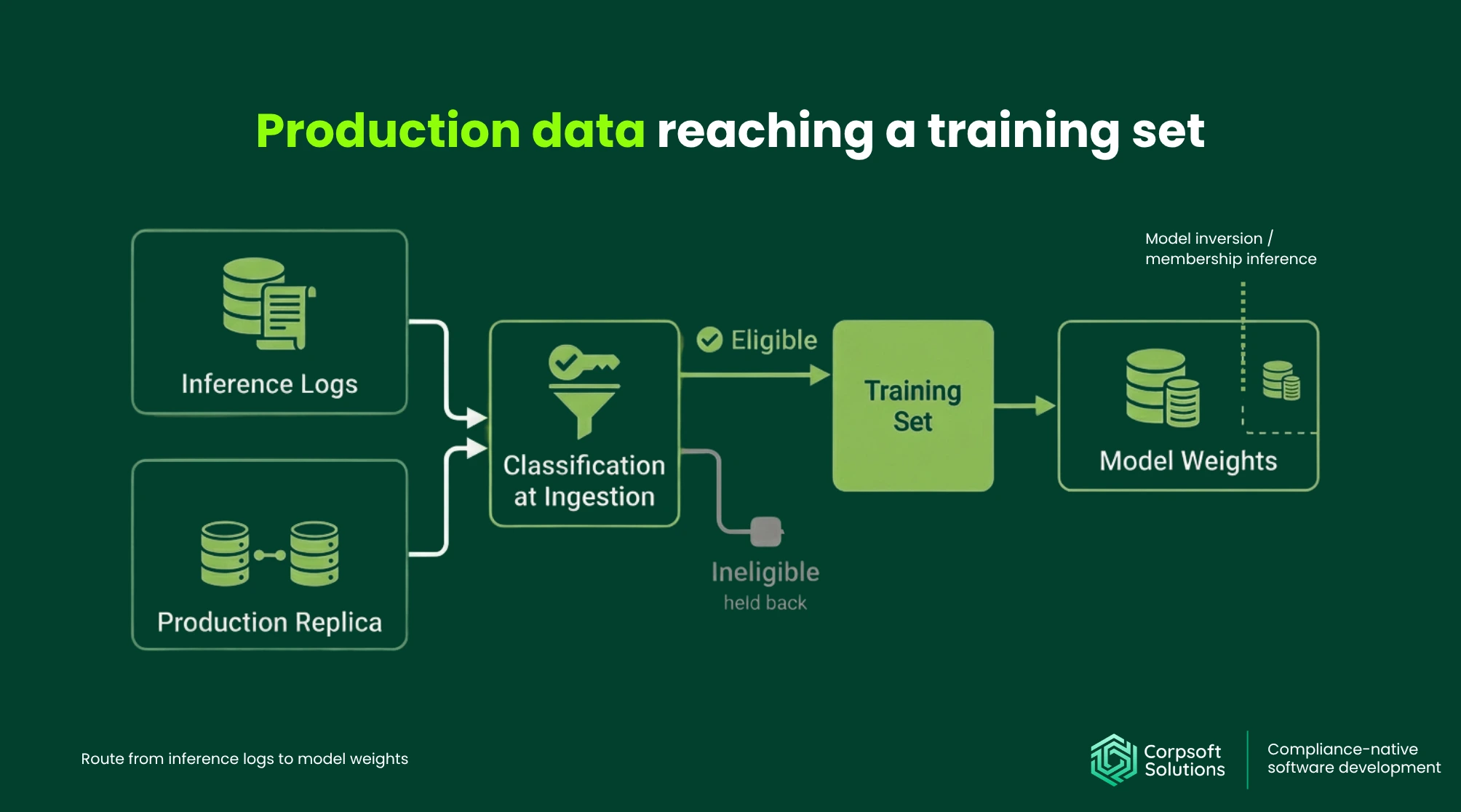
Path one is any route by which live data carrying protected health information becomes training or fine-tuning input.
The routes into a training set are ordinary engineering decisions:
- Inference logs retained for debugging, then mined for a fine-tuning set built from the last quarter of traffic.
- A training job pointed at a production replica, because that was the fastest way to get volume.
Training data privacy is decided before the job runs, which is why this path is easy to close early and awkward to close late.
Once personal data has influenced model parameters, answering a GDPR erasure request becomes technically awkward: there is no record-level delete operation for weights. Depending on the system, remediation can mean retraining, replacing the model, or restricting access.
LLM data leakage: how a trained model gives the data back
A model inversion attack can infer or reconstruct information about the data a model was trained on, depending on the model and the attacker’s access. A membership inference attack answers a narrower question: whether one specific record was part of the training set.
For a healthcare product, the second one is enough on its own. If a model was trained on patients who share a diagnosis, confirming that a named individual is in that training set discloses the diagnosis.
Training data extraction is the clearest form of LLM data leakage at the model level: Carlini et al. (2021) recovered verbatim names, phone numbers, and email addresses from GPT-2 by prompting it.
A model can reproduce memorized strings from its training data, particularly strings that are rare or repeated. Free-text clinical notes are full of rare strings.
How to control path one
These controls make this path governable. There are three of them.
- Separate the stores. Inference logs and training data live in different systems, with the separation enforced at write time. A job that can read one has no path to the other.
- Classify at ingestion. Records carrying protected health information are tagged when they arrive, and the tag is what makes a record ineligible for a training job.
- Record provenance. For every training set, keep the source of each input and the basis on which it was collected. This is also the artifact an auditor asks for first.
Differentially private training, usually DP-SGD, limits what a membership inference attack can recover from a model, at a measurable loss in accuracy.
Path two: AI data exposure points in a third-party API call
Training a model on your own data and letting a provider train on your inputs are different risks with different owners. The second one belongs here: a vendor whose default terms permit training on API inputs, on a page nobody read past the pricing table.
Every call to an external model provider moves your users’ data outside your infrastructure. Four AI data exposure points open with it:
- How long the provider retains the payload
- Whether your inputs are eligible to train the provider’s models
- Which region processes the request
- Which subprocessors sit behind the endpoint
Generative AI data leakage through a third-party endpoint rarely involves anything hidden. Each of the four exposures is documented somewhere in the provider’s published terms, in a version tied to a specific plan. That can be the general terms of service, a data processing addendum, or a separate subprocessor page.
The gap opens between the provider’s enterprise page and the terms attached to the API key an engineer generated on a corporate card to unblock a demo. That key’s plan decides your LLM data privacy position.
Contract language assumes the data can be handed back. Under 45 CFR §164.504(e), a business associate must, at termination and if feasible, return or destroy the protected health information it still holds. That presumes it can be located; for data already absorbed into a vendor’s model weights, there is no clean technical way to do that.
The contractual side has three artifacts worth holding:
- the applicable BAA or DPA, with the AI processing covered by its scope
- a current subprocessor list
- a data residency commitment
Popular SaaS Tools That Create Third-Party Compliance Risk: A Developer’s Guide works through that evaluation vendor by vendor. How a team decides which vendors get reviewed, and how often, is the subject of Third-Party Software Security Assessment: What to Check and Why Most Teams Skip It.
In May 2026, hundreds of malicious packages were uploaded to the RubyGems registry. Researchers attributed them to agents being tested internally by OpenAI. OpenAI confirmed the incident and described the activity as benign retrieval of public information (Guardian). A separate incident involving OpenAI agents and Hugging Face followed in July.
None of the four exposures above would have caught either one. Both sat inside the vendor’s own infrastructure, beyond anything a customer sent or received. The controls below are therefore built around the boundary a customer can actually govern: the gateway.
How to control path two
Route every model call through one internal gateway. One control point is easier to test than twelve copies of the same logic, and easier to change when a provider’s terms move.
- Redaction before the call leaves. The model receives the structure of the request, and identifiers stay inside the perimeter.
- An allowlist in the request path. Approved providers are enforced centrally, in the request path, before an unapproved endpoint can receive production data; a CI check is one way to catch it earlier. A list that lives only in a document, with nothing enforcing it at request time, is a policy.
- Residency as configuration. Pin the provider and deployment configuration to an approved processing geography, and verify the provider’s current terms for that deployment mode. Microsoft’s Foundry documentation states that prompts and responses are processed within the customer-specified geography unless the deployment type is Global or DataZone, each of which carries its own processing rules.
- Retention terms for the key in use. OpenAI’s data controls documentation describes zero data retention as an option requiring prior approval. ZDR addresses retention and leaves the other three exposures where they were.
The last control is the egress log. What goes into it decides whether the log helps or becomes a liability of its own. Store the decision, and leave the payload out:
- Destination and model
- Request ID and data classification
- Redaction result and policy decision
Keep the minimum needed to reconstruct the event. A raw payload sitting in a log store opens a fourth way out of the system, and GDPR-Compliant AI: What Engineers Need to Log, Trace, and Explain covers what belongs in that record.
Path three: data that was supposed to be anonymous
Under the GDPR, genuinely anonymized information falls outside the definition of personal data (Recital 26). Pseudonymized data stays inside it: for the controller holding the key, it remains personal data.
The CJEU’s 2025 judgment in EDPS v SRB accepted that a recipient without the means to re-identify may hold data that is not personal for them, and it left the sender’s obligations in place. Identifiability was assessed at the point of collection, from the controller’s perspective.
Pseudonymization changes the risk profile. The applicable obligations still need to be assessed for the processing and the transfer.
Removing names is a weaker control than it looks. Sweeney’s 2000 analysis of 1990 U.S. Census data found that 5-digit ZIP code, sex, and date of birth were enough to uniquely identify about 87% of the population covered by that census.
The AI data leakage examples in this path trace back to four predictable places where redaction built for structured fields fails:
- Free-text clinical notes, where the identifying detail sits inside the narrative and never in a field
- Quasi-identifiers that recombine once datasets are joined
- Image metadata, where EXIF tags and DICOM headers survive a pipeline written to clean the pixels
- Embeddings computed from raw text before the redaction step, which carry forward what redaction was meant to remove.
The third of those has an architectural answer that is easy to overlook: sometimes the right decision is to stop trying to anonymize.
System. A HIPAA-compliant dermatology telemedicine platform built by Corpsoft Solutions, where patients upload skin images for remote assessment and an AI model runs a preliminary analysis before a licensed dermatologist reviews the case.
Problem. A clinical skin image is identifiable on its own, and it arrives carrying whatever the patient’s device attached to it.
Risk. Treating such an image as anonymous once a name field is cleared would leave the identifying content untouched.
Architecture decision. Images were treated as protected health information from intake onward, with HIPAA-aligned access controls and audit logging applied to them as clinical records.
Evidence. Disclosure: this is Corpsoft Solutions’ own project, and the published case study maps each control to the HIPAA safeguard behind it.
Keeping the data identified and controlling access to it is a legitimate answer to path three whenever de-identification cannot be made to hold.
HIPAA names two methods. Safe Harbor removes 18 specified identifiers and requires that the covered entity have no actual knowledge that the remaining information could identify someone. Expert Determination requires a qualified person to document that the risk is very small (45 CFR §164.514).
HIPAA’s Expert Determination standard already names the test that decides the outcome: whether the information, alone or in combination with other reasonably available information, could identify an individual.
NIST SP 800-122 applies the same logic to federal systems, where de-identified records keep a low impact level only while they cannot be linked back to a person through public or other reasonably available records. That condition is the quasi-identifier problem stated as a control. A regular expression that removes names from one field is not, by itself, either de-identification method.
Privacy concerns with AI in healthcare show up most clearly here, because clinical data combines structured identifiers with free text that resists redaction built for records.
Which data anonymization techniques hold at inference time?
Data anonymization techniques are built for different data shapes, and the technique that fits a tabular export can fail on the input an AI feature receives.
| Technique | Best suited to | Limitation in an AI pipeline |
| Masking | Structured fields | Misses identifiers embedded in free text |
| Tokenization | Reversible workflows | Tokenized data stays linkable to the original identity |
| Generalization and k-anonymity | Structured datasets | Linkability can persist when datasets are combined |
| Differential privacy | Controlled statistical and model releases | Needs a defined privacy budget and mechanism, and does not replace input redaction |
LLM data leakage prevention: one boundary, three gates
All three paths cross the same boundary at different points. Corpsoft Solutions’ AI Compliance Stack groups the controls above into its Data Governance layer, and its other two layers, Model Governance and Regulatory Compliance, are defined in full in AI Regulatory Compliance: Where Most Pilots Get Stuck — and How to Prevent Failure.
LLM data leakage prevention, described as architecture, is a gate at each boundary and a record from each gate:
| Leakage route | Control point | Evidence |
| Production data enters training | Classification at ingestion + isolated training pipeline | Provenance record per training set |
| Sensitive data leaves through a model provider | Central egress gateway + provider policy | Egress decision log + provider terms for the key in use |
| Supposedly anonymous data stays identifiable | De-identification before AI processing, chosen for the data shape | Documented method + linkability assessment |
A control that works and leaves no record behind is indistinguishable, during a security review, from one that was never built. What a buyer asks to see in such a review is the subject of Enterprise AI Security: What Buyers Actually Ask Before They Sign.
How do you find out whether your product has an AI data leak?
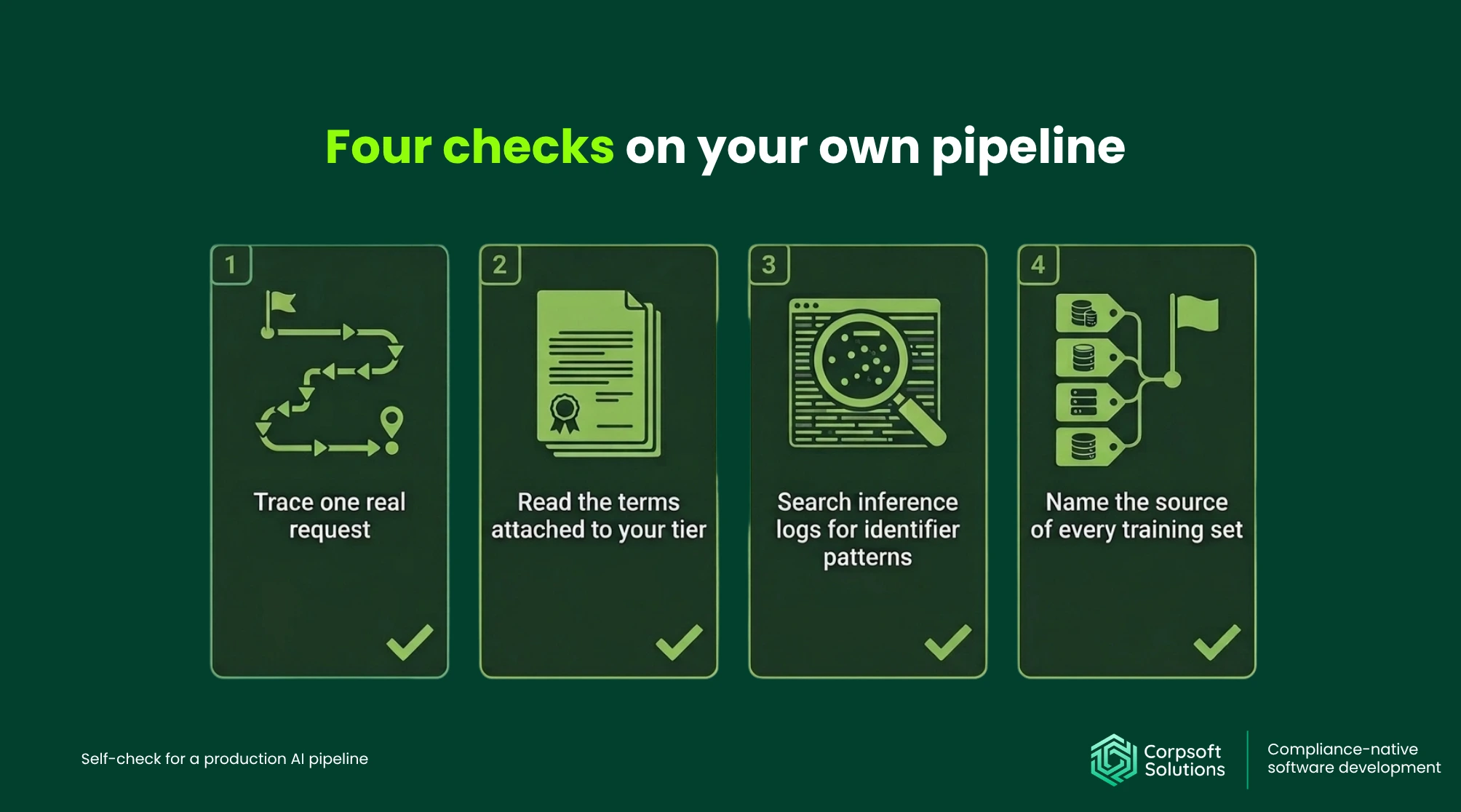
Four checks run against the live pipeline.
- Trace one real request end to end. Take a single production request carrying sensitive data and list every system that saw the payload:
-
- Services and queues
- Log sinks and external endpoints
A passing result is a list you could have written from memory. A failing result is a list with an entry you did not expect.
2. Read the terms attached to your tier. Find the API key your service uses, identify its plan, and read what that plan says about retention and training. A passing result is a URL and a plan name. A failing result is a recollection of a sales conversation.
3. Search your inference logs for identifier patterns. Run pattern matching for the identifier formats your product handles. Pattern matching catches structured identifiers and misses the ones embedded in narrative text, so zero matches rules out the structured cases only. Investigate false positives before counting them.
4. Name the source of every training set. For each set used to train or fine-tune a model in production, state where the data came from and on what basis it was collected. A passing result is a written answer per set. A failing result is one set nobody can account for.
Corpsoft Solutions’ 7-Day Risk Assessment runs the same checks with read-only access and returns findings ranked from Critical to Low.
A team that clears all four has checked these three paths. Other exits may still exist, and the checks say nothing about them.
An engineer who can trace where a patient’s data goes after a single request, without opening a spreadsheet, has the boundary in view. A team that cannot has an architecture problem before it has a contract problem.
Related questions worth exploring
Wondering which governance controls give way once a system grows past its first production cluster? AI Data Governance: What Breaks at Scale, and What Fixes It walks through four failure points, from consent tracking to audit log volume.
Looking for the full risk inventory across a generative AI stack? Top Generative AI Security Risks to Monitor in 2026 maps each risk to its compliance obligation.
Preparing an AI feature for external regulatory review? AI Regulatory Compliance: Where Most Pilots Get Stuck — and How to Prevent Failure covers what reviewers look for when a pilot moves toward production.
Share this post: